
Food waste in retail starts with what isn’t seen, not just what’s thrown away.
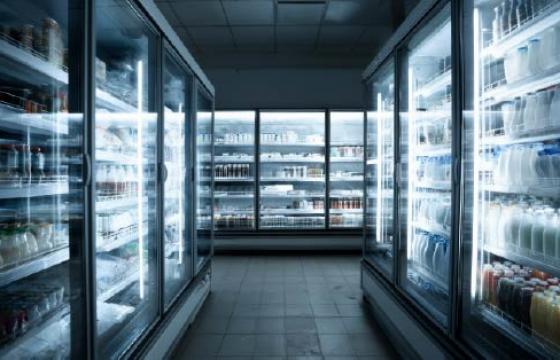
Right now, there is a fridge running two degrees warmer than it should be, unfortunately nobody knows yet apart from the poor staff member who has the smell of off milk in their nose. By the time an engineer is called, thousands of pounds of product will already be heading for a skip, and the carbon cost of growing, transporting and refrigerating all of it will evaporate into nothing.
This happens every day.
We often talk about food waste in the language of guilt. Things like the forgotten leftovers, or the wilted salad. And it's true because UK households bin 4.4 million tonnes of edible food every year, roughly £1,000 per family. But for retailers, the scale is categorically different, and so is the mechanism. The waste isn't happening because someone forgot to check the fridge. It's happening because the fridge itself is operating blind.
The real problem is invisible failure
Consider what a single refrigeration failure actually costs. It's not just the stock in that unit, it's the cascade effect across an estate when an engineer is scrambling rather than preventing. It's the emergency call-out fee. It's the disposal cost of spoiled goods. And increasingly, it's a carbon liability. Food waste is one of the most carbon-intensive line items in a retailer's Scope 3 account, because it represents the entire embedded cost of production – water, land, energy, transport – written off at the final step.
For major food retailers, Scope 3 emissions account for more than 90% of their total carbon footprint. Regulators are catching up fast. Corporate Sustainability Reporting Directive (CSRD) in Europe and the UK's Sustainable Disclosure Requirements (SDR) are moving food waste from a corporate social responsibility talking point to a hard reporting obligation. The fridge that nobody's watching is about to become a very visible problem.
Predictive beats reactive, every time
The shift that moves the needle isn't recycling programmes or markdown stickers (though both help at the margin). It's moving from reactive to predictive – knowing the fridge is failing before the milk does.
This is exactly what IMS Evolve does. By laying a software layer over existing refrigeration infrastructure – no rip-and-replace, no capital overhaul – we analyse health and performance patterns in real-time so anomalies surface hours or days before a critical failure.
That window is the difference between a maintenance visit and a mass spoilage event. Across a large estate, eliminating even a handful of those events per year delivers returns that dwarf the cost of the technology enabling them.
Overstocking is where waste quietly builds
Food retailers order stock based on forecasts built on the best information available at the time, with a degree of uncertainty that is unavoidable. The buffer built into those forecasts (the stock cushion that protects against empty shelves) is where waste quietly accumulates.
It doesn't make the news. It just moves from shelf to markdown to bin, week after week.
Feeding real-time storage and sales data into demand forecasting changes the calculation. When you know precisely what's in the estate, at what temperature, you can order closer to actual demand. The margin of error shrinks. The waste shrinks.
The economics are now unarguable
Food waste tends to be framed as a moral question.
It partly is. But in 2026, with operational costs where they are and mandatory GHG reporting looming, it's also just good business. Every tonne of food saved is margin recovered. Every avoided spoilage event is an engineer call-out that didn't happen. Every accurate failure forecast is stock that didn't end up in a skip.
The retailers who treat food waste in this way will have a structural cost advantage over those still waiting for the milk to go off.

In the latest blog, our CEO Frank Jones shares his 2026 musings, from the importance of connected ecosystems to ensure a...

We've put pen to paper to summarise IMS' 2025 ahead of the Christmas holdiays and explore what new opportunities await us in the new...

We spoke to our Managing Director, Jason Murphy, about how this year’s extreme summer has impacted the cool supply chain and...
